Most safety meetings fail the moment they start. They’re generic, rushed, or treated as a box-ticking exercise. Workers zone out. Supervisors read from memory. And when an incident occurs, the investigation reveals: no documented proof of real discussion.
That’s where a structured toolkit talk template PDF changes everything. It’s not just a form—it’s a communication framework. One that ensures every safety conversation is relevant, documented, and actionable. And yes, you can download a free, customizable toolbox talk template PDF that works across industries—construction, manufacturing, utilities, and more.
Here’s how to use it, why most teams misuse it, and where to get a version that actually drives engagement.
What Is a Toolbox Talk Template?
A toolbox talk template is a standardized form used to guide short, focused safety discussions—typically 10 to 15 minutes—held before work begins. These talks address specific hazards, procedures, or changes in workflow relevant to the day’s tasks.
Unlike lengthy safety manuals, toolbox talks are practical. They’re designed to be conversational, not read aloud like a script. The template standardizes the format so nothing critical is missed: topic, hazards, controls, attendance, and sign-off.
Key Components of Any Effective Template
A high-quality toolbox talk template includes: - Topic/Subject (e.g., working at height, electrical safety) - Date and work location - Facilitator name and role - Hazard identification (what could go wrong?) - Risk controls (what are we doing to prevent it?) - Attendee list with signatures - Space for questions or observations
Leave any of these out, and the talk loses legal defensibility and practical value.
A common mistake: Using a one-size-fits-all template for every job. A talk about trench safety should not use the same form structure as one about heat stress—each needs tailored hazard prompts.
Why You Need a PDF Template (Not Just Any Format)
You’ll find toolbox talk templates in Word, Excel, Google Docs, and even apps. But a PDF version offers distinct advantages:
- Universal compatibility – opens on any device without formatting issues
- Print-ready – crucial for job sites with spotty internet
- Secure and tamper-resistant – once filled and saved, it’s locked
- Easy archiving – consistent file naming enables fast retrieval during audits
That’s why a free downloadable toolbox talk template PDF is the smart choice for supervisors who need reliability, not just convenience.
But not all PDFs are created equal.
Many free templates online are either too sparse (missing key fields) or overcomplicated (slowing down the meeting). The best balance clarity, compliance, and usability.
Free Toolbox Talk Template: What’s Included in Our Download
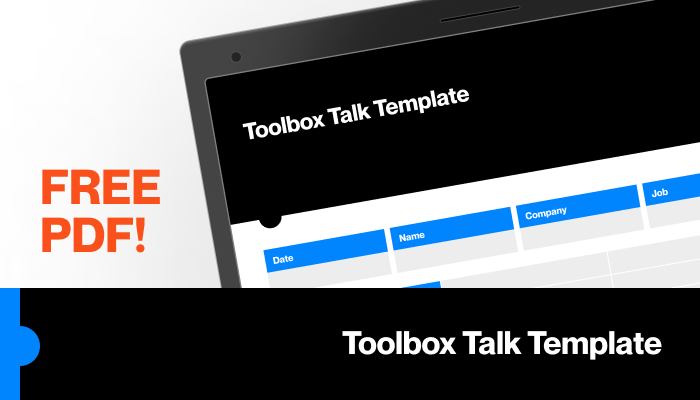
Our free toolbox talk template PDF is designed for real-world use—not theoretical safety models. Here’s what you get:
✅ Editable text fields – customize topics and roles without reformatting ✅ OSHA-aligned structure – covers required elements for compliance ✅ Attendee signature section – legal proof of participation ✅ Hazard and control checklist – prompts discussion, not silence ✅ Clean layout – readable even when printed on a phone or tablet
It works whether you’re managing a 3-person crew or a 50-person site. And because it’s in PDF, you can use it digitally (via tablets) or print copies daily.
Tip: Save a master copy. Rename each instance with the date and topic (e.g., “Toolbox_Talk_Forklift_Safety_0415.pdf”) for easy filing.
5 Real-World Use Cases for This Template
Templates only work if they’re used. Here’s how safety leaders actually apply them:
1. New Crew Onboarding
Before a new worker touches equipment, run a 10-minute talk on site-specific risks. Document their attendance and understanding. This template becomes proof of orientation.
2. Changing Weather Conditions Heatwave? Ice on walkways? Use the form to highlight environmental risks and controls (hydration, PPE, slip prevention). Update the topic daily if needed.
3. Equipment Introduction Rolling out scissor lifts or new PPE? Run a talk focused only on that tool. Use the hazard section to let workers voice concerns—often, they spot risks supervisors miss.
4. Near-Miss Follow-Up
After a close call, use the template to discuss what happened, why, and how to prevent recurrence. This turns reactive moments into proactive learning.
5. Contractor Coordination Multiple vendors on site? Require each team lead to submit a completed talk before starting work. Ensures alignment and shared responsibility.
Example: A roofing crew used the template after a ladder slipped on wet shingles. The talk revealed two workers weren’t trained on soft-surface anchoring. A 15-minute conversation prevented a future fall.
Top 5 Free & Paid Options for Toolbox Talk Templates (PDF)
While our free template covers most needs, here are five solid alternatives—each with trade-offs.
| Option | Format | Editable | Best For | Notes |
|---|---|---|---|---|
| OSHA.gov Sample | No | Compliance baseline | Basic structure, not customizable | |
| SafetyInfo.com | PDF + Word | Yes (Word) | Small teams | Requires email sign-up |
| Creative Safety Supply | Yes | Visual learners | Includes icons and flowcharts | |
| SafetyCulture (iAuditor) | App → PDF export | Yes | Digital-first teams | Free tier limited to 5 reports/month |
| EHS Doc Shop (Premium) | PDF + Excel | Yes | Enterprise compliance | $49 one-time, includes log tracker |
Verdict: For most teams, a free, editable PDF like ours strikes the right balance. Only move to paid tools if you need automated reporting or integrations.
Warning: Avoid templates with vague prompts like “discuss safety.” Replace with “identify 2 fall hazards on this site” to force engagement.
Common Mistakes That Undermine Toolbox Talks
Even with a great template, execution matters. Watch for these pitfalls:
❌ Reading the Template Like a Script If the supervisor reads every line aloud, workers disengage. The form should prompt dialogue, not replace it.
Fix: Use the hazard section to ask, “What risks do you see today?” Then fill in the form based on discussion.
❌ Using the Same Topic Weekly “PPE” every Monday? Workers tune out. Rotate topics and make them situational.
Fix: Plan a monthly calendar—week 1: lifting safety, week 2: noise exposure, etc.
❌ Skipping Signatures No signatures = no proof. If OSHA shows up, you can’t claim talks happened.
Fix: Make signing as routine as clocking in. Use clipboards on site.
❌ Failing to Store Copies Paper forms get lost. Digital files get buried.
Fix: Create a shared folder (cloud or server) with subfolders by month. Archive weekly.
How to Customize the Template for Your Team
A generic form won’t cover niche risks. Customize yours in 3 steps:
- Add Site-Specific Hazards
- Include common risks like “overhead power lines near crane path” or “confined space entry in pump station.”
- Insert Company Branding
- Add your logo, safety slogan, or contact info for the safety officer. Builds ownership.
- Integrate Required Checkpoints
- If your state mandates heat illness prevention plans, add a checkbox for daily high-temp alerts.
Pro tip: Run a pilot with two crews—one using the standard template, one with custom fields. Compare engagement and incident rates after 30 days.
Making Toolbox Talks Stick: The 10-Minute Discipline
Great templates support great habits. But discipline turns safety talks into culture.
- Follow this workflow:
- Choose a relevant topic the night before or morning of
- Grab your printed or digital template
- Gather the crew in a safe, quiet spot
- Facilitate—don’t lecture (ask questions, encourage stories)
- Fill in the form together
- Collect signatures
- File immediately
Do this daily, not weekly. Frequent, short talks reduce incidents more than long, rare ones.
Data point: According to the National Safety Council, companies that conduct daily toolbox talks see up to 35% fewer recordable incidents.
Final Step: Download Your Free Toolbox Talk Template PDF
Stop using disorganized notes or nothing at all. A free toolbox talk template PDF is the simplest upgrade you can make to your safety process.
It creates accountability. It fosters communication. And when done right, it doesn’t feel like compliance—it feels like care.
Download the template, customize it for your team, and run your first talk tomorrow. Not next week. Not “when things slow down.” Tomorrow.
Because the best time to prevent an incident was yesterday. The second-best time is right now.
Frequently Asked Questions
Where can I get a toolbox talk template for free? You can download a free, editable PDF toolbox talk template from trusted safety sites like OSHA.gov, SafetyInfo.com, or directly through safety supply vendors. This article includes a recommended free version designed for real-world use.
Can I edit a PDF toolbox talk template? Yes—only if it’s created with fillable fields. Our free template includes editable text boxes for topic, date, hazards, controls, and signatures, so you can customize it without design tools.
How often should toolbox talks be held? Ideally, daily. At minimum, weekly. Frequency increases effectiveness, especially when topics are tied to current tasks, weather, or equipment changes.
Are toolbox talks required by OSHA? Not explicitly, but OSHA requires employers to train workers on job hazards. Toolbox talks are a recognized, compliant way to document this training and communication.
Should toolbox talks be signed? Yes. Signatures verify attendance and understanding. Without them, you lack proof that the talk occurred—putting you at risk during inspections or incident investigations.
What topics should I cover in toolbox talks? Focus on immediate risks: working at height, lockout/tagout, PPE use, slips/trips/falls, equipment operation, and environmental hazards like heat or noise.
Can I use a digital toolbox talk template on a tablet? Absolutely. Save the PDF to your device, use a note or PDF app with annotation tools, and collect digital signatures. Just ensure files are backed up and organized.
FAQ
What should you look for in Free Toolbox Talk Template PDF Download for Safety Teams? Focus on relevance, practical value, and how well the solution matches real user intent.
Is Free Toolbox Talk Template PDF Download for Safety Teams suitable for beginners? That depends on the workflow, but a clear step-by-step approach usually makes it easier to start.
How do you compare options around Free Toolbox Talk Template PDF Download for Safety Teams? Compare features, trust signals, limitations, pricing, and ease of implementation.
What mistakes should you avoid? Avoid generic choices, weak validation, and decisions based only on marketing claims.
What is the next best step? Shortlist the most relevant options, validate them quickly, and refine from real-world results.